
201 vs 202 Stainless Steel: Composition, Strength, Corrosion Resistance, Cost & Applications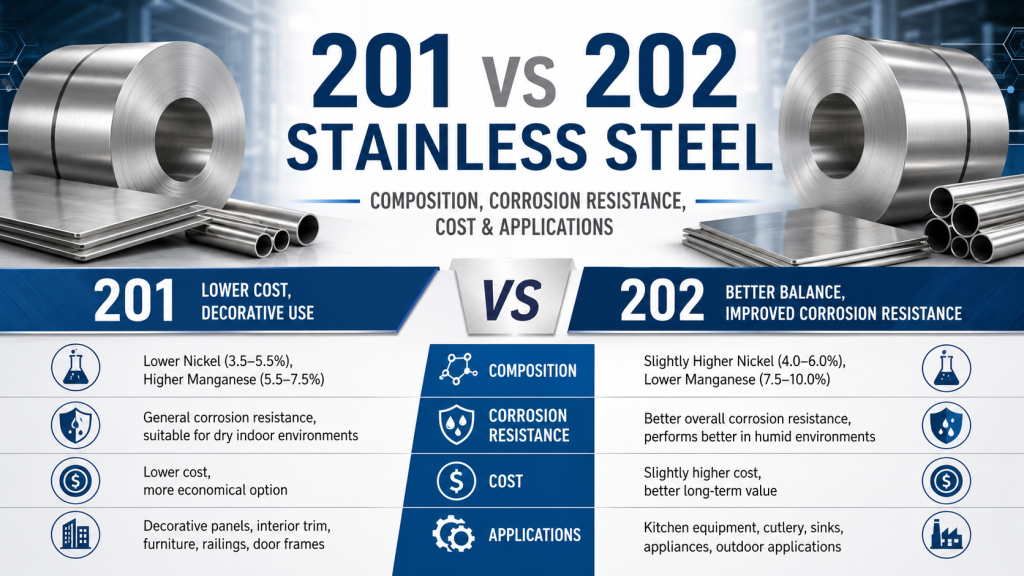
When comparing 201 vs 202 stainless steel, buyers often focus only on price. However, these two 200-series stainless steel grades differ in chemical composition, corrosion resistance, toughness, workability and long-term application value.
Both 201 and 202 are nickel-saving austenitic stainless steels. They use manganese and nitrogen to replace part of the nickel content, making them more economical than common 300-series stainless steels such as 304. However, lower nickel content also means that their corrosion resistance is usually weaker than 304 and 316 stainless steel.
This guide explains the real differences between 201 and 202 stainless steel, including composition, mechanical properties, corrosion resistance, fabrication performance, cost and application selection. For more stainless steel material information, visit the Jude Steel Stainless Steel Grade Center.
Fast Comparison: 201 vs 202 Stainless Steel
| Feature | 201 Stainless Steel | 202 Stainless Steel |
|---|---|---|
| Steel Family | 200-series austenitic stainless steel | 200-series austenitic stainless steel |
| Main Alloying Strategy | Lower nickel, higher manganese and nitrogen | Chromium-nickel-manganese stainless steel |
| Nickel Content | Lower | Usually higher than 201 |
| Chromium Content | Moderate | Usually higher than 201 |
| Устойчивость к коррозии | Fair to moderate | Moderate, generally better than 201 |
| Strength | High strength due to manganese and nitrogen | High strength with better toughness balance |
| Formability | Good for many decorative applications | Good, often slightly better in selected forming applications |
| Стоимость | Usually lower | Usually higher than 201, lower than many 300-series grades |
| Typical Applications | Decorative tubes, indoor panels, furniture, low-cost appliances | Decorative pipes, kitchen utensils, shallow drawing parts, indoor structures |
1. What Is 201 Stainless Steel?
201 stainless steel is a 200-series austenitic stainless steel developed as a lower-nickel alternative to conventional chromium-nickel stainless steels. It uses manganese and nitrogen to maintain strength while reducing nickel cost.
Because of its cost advantage, 201 stainless steel is widely used in decorative, indoor and light-duty applications. Jude Steel provides related grade information here: 201 Stainless Steel Grade.
Main Characteristics of 201 Stainless Steel
- Lower nickel content than 304 stainless steel
- Higher manganese and nitrogen content
- Good strength and hardness
- Attractive surface appearance after polishing or brushing
- Cost-effective for decorative and indoor applications
- Lower corrosion resistance than 304 and 316 stainless steel
- Not ideal for coastal, chloride-rich or highly humid environments
Typical Applications of 201 Stainless Steel
- Decorative stainless steel tubes
- Indoor handrails
- Furniture components
- Appliance decorative parts
- Interior wall panels
- Kitchen utensils for dry or mild-use environments
- Low-cost stainless steel fabrication
2. What Is 202 Stainless Steel?
202 stainless steel is also a 200-series austenitic stainless steel. Compared with 201, it usually contains higher chromium and nickel, while still using manganese and nitrogen to reduce reliance on nickel.
202 stainless steel offers a useful balance of strength, toughness, moderate corrosion resistance and cost efficiency. It is commonly used for decorative pipes, utensils, indoor structures and shallow forming products. Jude Steel provides related grade information here: 202 Stainless Steel Grade.
Main Characteristics of 202 Stainless Steel
- Chromium-nickel-manganese austenitic stainless steel
- Generally better corrosion resistance than 201
- Good toughness and strength
- Suitable for shallow drawing and forming applications
- Cost lower than many 300-series stainless steels
- Better performance than 201 in selected decorative and structural uses
Typical Applications of 202 Stainless Steel
- Decorative stainless steel pipes
- Kitchen utensils
- Railings and indoor structures
- Shallow drawing products
- Industrial pipes for mild environments
- Appliance components
- General decorative fabrication
3. Chemical Composition Comparison
The performance difference between 201 and 202 stainless steel starts with chemical composition. Both grades use manganese and nitrogen to reduce nickel demand, but 202 usually contains higher chromium and nickel than 201.
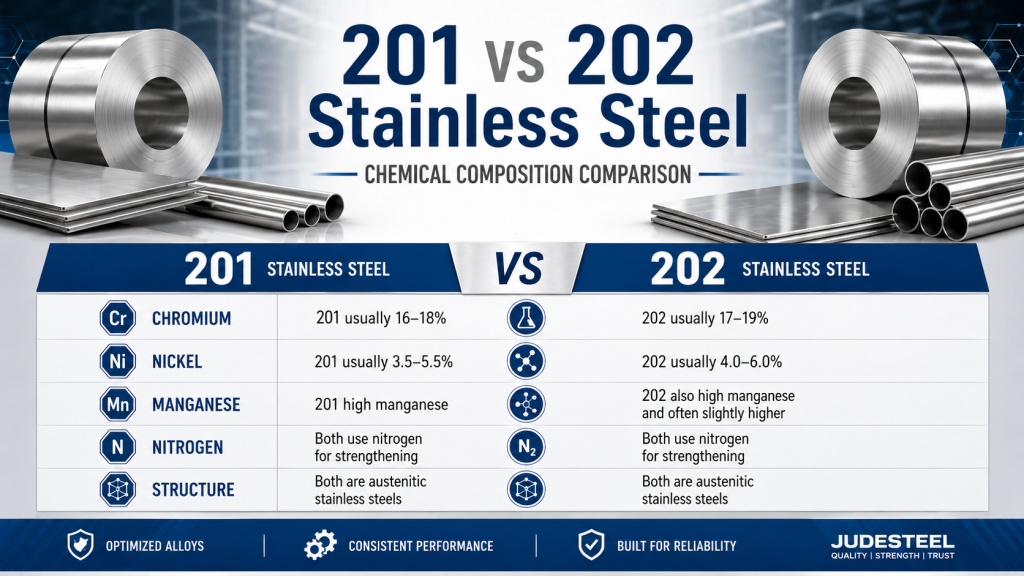
Chemical composition comparison: 202 usually has higher chromium and nickel, while both grades use manganese and nitrogen for nickel-saving design.
| Элемент | 201 Stainless Steel | 202 Stainless Steel |
|---|---|---|
| Carbon (C) | Controlled, commonly ≤ 0.15% | Controlled, commonly ≤ 0.15% |
| Chromium (Cr) | Usually around 16.0%–18.0% | Usually around 17.0%–19.0% |
| Nickel (Ni) | Usually lower, commonly around 3.5%–5.5% | Usually higher, commonly around 4.0%–6.0% |
| Manganese (Mn) | High manganese content | High manganese content, often higher than 201 |
| Nitrogen (N) | Added to improve strength | Added to improve strength and stability |
| Microstructure | Austenitic | Austenitic |
Why Manganese and Nitrogen Matter
Manganese and nitrogen help stabilize the austenitic structure and increase strength. This is why 200-series stainless steels can maintain good mechanical performance while using less nickel than 304 stainless steel.
However, nickel reduction also affects corrosion resistance and formability. Therefore, 201 and 202 should be selected carefully based on working environment and product requirements.
4. Mechanical Properties: Strength, Hardness and Toughness
Both 201 and 202 stainless steel offer good strength. In many cases, they can provide higher strength than standard annealed 304 stainless steel due to the strengthening effect of manganese and nitrogen.
| Недвижимость | 201 Stainless Steel | 202 Stainless Steel |
|---|---|---|
| Strength | High | High |
| Твердость | Good | Good |
| Toughness | Moderate to good | Generally good |
| Ductility | Good for many applications | Good, often better balanced than 201 |
| Cold Working Response | Strong work hardening tendency | Good work hardening performance |
Practical Meaning
- 201 stainless steel is suitable for cost-sensitive decorative parts.
- 202 stainless steel is often selected when better toughness or slightly better overall performance is required.
- Both grades can be used for tubes, sheets and decorative components.
- For heavy-duty corrosion-resistant applications, 304, 316L or duplex stainless steel should be considered.
5. Corrosion Resistance Comparison
Corrosion resistance is one of the most important differences between 201 and 202 stainless steel. While both grades are stainless steels, they are not designed for highly corrosive environments.
Because 202 usually contains higher chromium and nickel than 201, it generally provides better corrosion resistance. However, both grades are still weaker than 304 and 316L in humid, coastal or chloride-rich environments.
| Environment | 201 Stainless Steel | 202 Stainless Steel |
|---|---|---|
| Dry Indoor Environment | Good | Good to very good |
| Decorative Indoor Use | Suitable | Suitable |
| Humid Environment | Use with caution | Better than 201, but still use caution |
| Coastal / Salt Exposure | Not recommended | Not recommended for long-term exposure |
| Food Processing Environment | Limited use | Limited use; 304 or 316L is preferred |
| Chemical Environment | Not recommended | Not recommended |
6. Formability and Fabrication
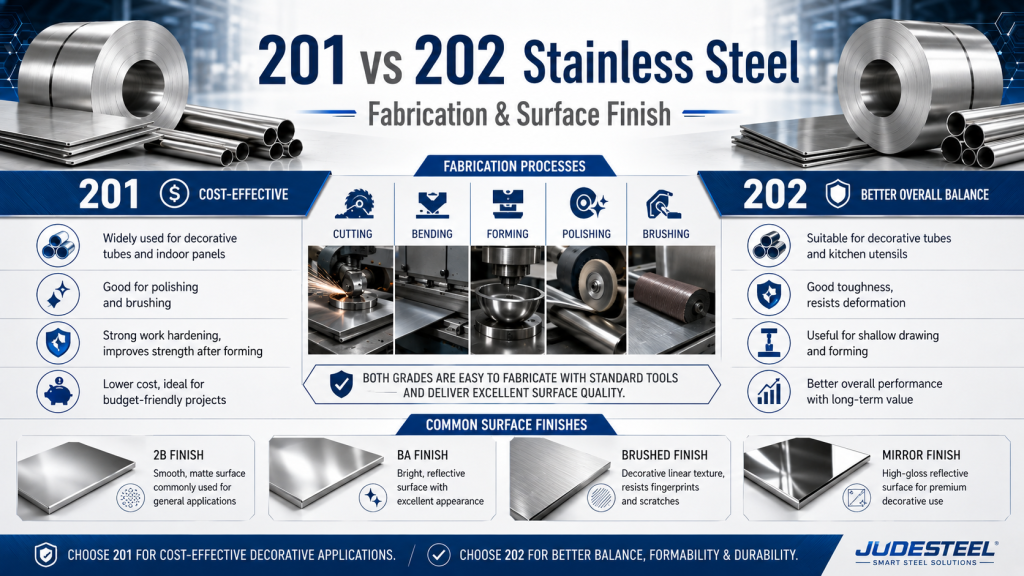
201 and 202 stainless steel can be cut, bent, polished, brushed, welded and formed into many decorative products. However, their formability differs from 304 stainless steel, especially in deep drawing applications.
Both 201 and 202 can be processed into sheets, coils, strips, tubes and decorative components with proper fabrication control.201 Stainless Steel Fabrication
- Good for decorative tubes and indoor panels
- Suitable for polishing and brushing
- Strong work hardening during forming
- More suitable for shallow forming than heavy deep drawing
- Cost-effective for large-volume decorative products
202 Stainless Steel Fabrication
- Good for decorative tubes and shallow drawing parts
- Better toughness balance in many applications
- Suitable for polishing, brushing and light forming
- Often used for kitchen utensils and indoor structures
- Better overall processing performance than low-grade substitutes
Jude Steel supplies stainless steel products including stainless steel sheet, stainless steel coil and stainless steel strip for industrial and commercial applications.
7. Surface Finish and Appearance
Both 201 and 202 stainless steel can achieve attractive surface finishes, making them popular in decorative markets. Common finishes include 2B, BA, brushed, mirror, hairline and polished surfaces.
| Surface Requirement | 201 Stainless Steel | 202 Stainless Steel |
|---|---|---|
| 2B Surface | Common and economical | Common and stable |
| BA / Bright Surface | Good decorative appearance | Good decorative appearance |
| Brushed / Hairline | Widely used | Widely used |
| Mirror Polishing | Possible with proper processing | Possible with proper processing |
| Decorative Tube Finish | Very common | Very common |
For visible decorative parts, buyers should confirm surface finish, protective film, scratch tolerance, thickness tolerance and final application environment before purchasing.
8. Cost Comparison
Cost is one of the biggest reasons why 201 and 202 stainless steel are widely used. Both grades reduce nickel content compared with 304 stainless steel, making them attractive for price-sensitive markets.
| Cost Factor | 201 Stainless Steel | 202 Stainless Steel |
|---|---|---|
| Raw Material Cost | Usually lower | Usually higher than 201 |
| Nickel Cost Exposure | Lower | Moderate |
| Performance Value | Excellent for dry indoor decorative use | Better balanced performance |
| Maintenance Risk | Higher if used in humid or salty environments | Lower than 201, but still application-dependent |
| Best Cost Scenario | Large-volume cost-sensitive decoration | Better performance with controlled budget |
9. Typical Applications of 201 Stainless Steel
- Decorative stainless steel tubes
- Indoor railings
- Furniture frames
- Interior decorative panels
- Appliance decorative components
- Display racks and shelves
- Low-cost stainless steel trim
- Dry indoor fabrication projects
10. Typical Applications of 202 Stainless Steel
- Decorative stainless steel pipes
- Kitchen utensils
- Indoor structural components
- Shallow drawing products
- Appliance parts
- Interior decoration
- Commercial furniture components
- Mild-environment industrial pipes
11. 201 vs 202 Stainless Steel: Quick Selection Guide
| Project Requirement | Recommended Grade | Reason |
|---|---|---|
| Lowest material cost | 201 Stainless Steel | Lower nickel content and strong price advantage |
| Better overall corrosion resistance | 202 Stainless Steel | Generally higher chromium and nickel content |
| Dry indoor decoration | 201 or 202 | Both can perform well when moisture exposure is limited |
| Kitchen utensils | 202 or 304 | 202 can be used for mild applications; 304 is better for higher hygiene requirements |
| Humid environment | 304 preferred | 201 and 202 are more rust-sensitive than 304 |
| Coastal environment | 316L preferred | Chloride exposure requires higher corrosion resistance |
| Decorative tubes | 201 or 202 | Depends on budget and performance requirement |
| Long service life with low maintenance | 304 or 316L preferred | Better corrosion resistance and reliability |
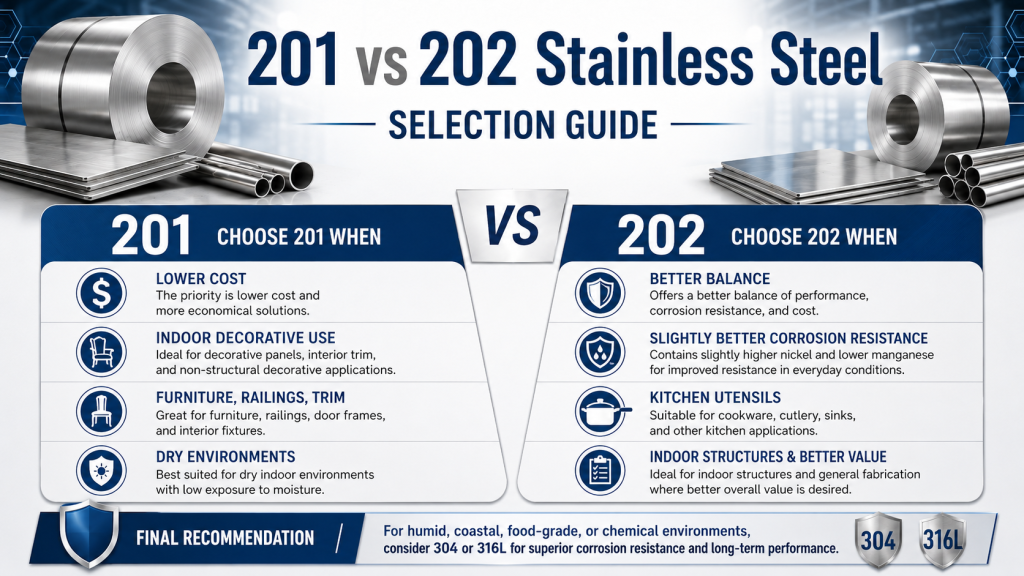 Selection guide: choose 201 for maximum cost control and 202 for better balanced performance in mild environments.
12. Which Grade Should You Choose?
Choose 201 Stainless Steel If:
- You need a lower-cost stainless steel material
- The application is dry and indoor
- The product is decorative rather than structural
- Corrosion exposure is limited
- The project requires polished or brushed decorative tubes
- You need a cost-effective alternative to 304 for non-critical use
Choose 202 Stainless Steel If:
- You need better overall performance than 201
- Moderate corrosion resistance is required
- The product needs better toughness and forming performance
- The application includes kitchen utensils or indoor structures
- You want a balance between cost and performance
- 304 is too expensive but 201 is not reliable enough for the application
Choose 304 or 316L Instead If:
- The product is used outdoors for a long time
- The environment is humid, salty or coastal
- Food-grade hygiene is important
- The product will contact chemicals or cleaning agents frequently
- Long service life and low maintenance are critical
13. Common Buyer Mistakes to Avoid
- Assuming 201 and 202 have the same corrosion resistance
- Using 201 stainless steel in coastal or wet environments
- Choosing material only by price per ton
- Ignoring surface protection during transportation and fabrication
- Using 200-series stainless steel where 304 or 316L is required
- Not checking thickness tolerance and surface finish before production
- Confusing polished appearance with long-term corrosion resistance
A bright stainless steel surface does not always mean high corrosion resistance. Correct grade selection must consider composition, environment, fabrication method and expected service life.
Frequently Asked Questions
What is the main difference between 201 and 202 stainless steel?
Both 201 and 202 are 200-series austenitic stainless steels. 202 usually contains higher chromium and nickel than 201, while both grades use manganese and nitrogen to replace part of the nickel content.
Is 202 stainless steel better than 201 stainless steel?
202 stainless steel generally provides better corrosion resistance, toughness and overall performance than 201. However, 201 is usually more cost-effective for dry indoor decorative applications.
Does 201 stainless steel rust?
Yes. 201 stainless steel can rust in humid, salty, acidic or chloride-rich environments. It is best used in dry indoor and decorative applications where corrosion exposure is limited.
Is 202 stainless steel suitable for kitchenware?
202 stainless steel can be used for some kitchen utensils and mild-use kitchen applications. However, for higher hygiene, corrosion resistance and long service life, 304 stainless steel is usually preferred.
Which is cheaper, 201 or 202 stainless steel?
201 stainless steel is usually cheaper because it contains less nickel. 202 typically costs more but may provide better overall performance.
Can 201 or 202 replace 304 stainless steel?
201 and 202 can replace 304 in selected cost-sensitive indoor applications. They should not replace 304 in humid, outdoor, food-grade, chemical or chloride-rich environments without technical evaluation.
Are 201 and 202 stainless steel magnetic?
In annealed condition, both are generally austenitic and usually non-magnetic or weakly magnetic. After cold working, they may become slightly magnetic.
Заключение
201 and 202 stainless steel are both economical 200-series stainless steels designed to reduce nickel cost while maintaining useful strength and decorative appearance. 201 stainless steel offers stronger cost advantages and is widely used in dry indoor decorative products, furniture, handrails and low-cost fabrication.
202 stainless steel usually provides better corrosion resistance, toughness and overall balance than 201, making it suitable for decorative pipes, kitchen utensils, shallow drawing parts and indoor structures where performance requirements are slightly higher.
The right choice depends on environment, budget and service life expectations. Choose 201 when cost control is the priority and corrosion exposure is low. Choose 202 when better performance is required without moving fully into 304 cost levels. For humid, coastal, food-grade or chemical applications, 304, 316L or duplex stainless steel should be considered.
Jude Steel supplies stainless steel sheets, coils, strips and customized processing solutions for global buyers. Explore more materials at Judesteel.com, or visit our product pages for stainless steel sheet, stainless steel coil and stainless steel strip.
