
18-8 vs 201 Stainless Steel: Corrosion, Cost & Applications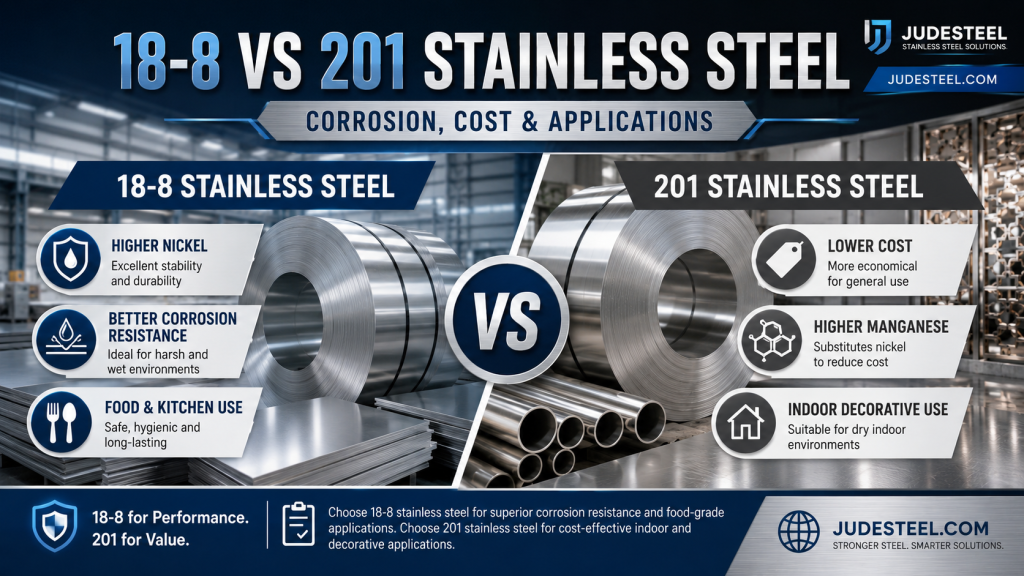
When comparing 18-8 vs 201 stainless steel, the most important question is not simply which grade is cheaper. The real decision depends on corrosion resistance, nickel content, mechanical strength, fabrication requirements, appearance, maintenance risk and expected service life.
18-8 stainless steel is commonly associated with 304-family austenitic stainless steel, known for its balanced chromium-nickel composition, good corrosion resistance and broad use in food, medical, kitchen and industrial applications. 201 stainless steel is a 200-series austenitic stainless steel designed to reduce nickel cost by using more manganese and nitrogen.
This guide explains the key differences between 18-8 and 201 stainless steel in chemical composition, corrosion resistance, strength, fabrication, cost and application selection. For more stainless steel material information, visit the Jude Steel Stainless Steel Grade Center.
Fast Comparison: 18-8 vs 201 Stainless Steel
| Feature | 18-8 Stainless Steel | 201 Stainless Steel |
|---|---|---|
| Stainless Steel Family | 300-series austenitic stainless steel, usually 304-family | 200-series austenitic stainless steel |
| Typical Meaning | About 18% chromium and 8% nickel | Lower nickel, higher manganese and nitrogen |
| Nickel Content | Higher | Lower |
| Manganese Content | Lower | Higher |
| Устойчивость к коррозии | Excellent for many general, food and indoor/outdoor environments | Moderate; best for dry indoor applications |
| Strength | Balanced strength and ductility | Higher strength and harder due to manganese and nitrogen |
| Formability | Превосходно | Good, but stronger work hardening may require more control |
| Weldability | Превосходно | Good for many applications, but lower than 18-8 in demanding fabrication |
| Стоимость | Higher | Lower |
| Best Use | Food equipment, medical instruments, kitchenware, outdoor hardware, general industry | Indoor decoration, furniture, appliance trim, low-cost tubes and panels |
1. What Is 18-8 Stainless Steel?
18-8 stainless steel is a common name for stainless steel that contains approximately 18% chromium and 8% nickel. In most industrial and commercial contexts, it usually refers to 304-family stainless steel.
The chromium content helps form a passive oxide film on the surface, while nickel improves austenitic stability, toughness, ductility and corrosion performance. Because of this balanced composition, 18-8 stainless steel is widely used in cookware, food equipment, fasteners, medical instruments and general fabrication.
For related grade information, see 304 Stainless Steel and 304L Stainless Steel.
Main Characteristics of 18-8 Stainless Steel
- Excellent general corrosion resistance
- Good resistance to rust and oxidation
- Strong balance of strength, toughness and ductility
- Excellent formability and weldability
- Suitable for food-contact and hygienic applications
- Usually non-magnetic in annealed condition
- More expensive than 201 stainless steel due to higher nickel content
Typical 18-8 Stainless Steel Applications
- Kitchen equipment and cookware
- Food processing machinery
- Medical and laboratory instruments
- Fasteners, screws and bolts
- Indoor and outdoor hardware
- Architectural components
- Storage tanks and general process equipment
- Stainless steel sheets, strips and fabricated parts
2. What Is 201 Stainless Steel?
201 stainless steel is a 200-series austenitic stainless steel. It was developed as a lower-cost alternative to nickel-rich stainless steels by replacing part of the nickel with manganese and nitrogen.
This composition gives 201 stainless steel relatively high strength and lower cost. However, its corrosion resistance is usually lower than 18-8 stainless steel, especially in humid, outdoor, coastal or chloride-rich environments.
For related grade information, see 201 Stainless Steel.
Main Characteristics of 201 Stainless Steel
- Lower nickel content than 18-8 stainless steel
- Higher manganese and nitrogen content
- Higher strength and hardness
- Good appearance after polishing or brushing
- Lower material cost
- More sensitive to rust in humid or chloride environments
- Best suited for dry indoor decorative applications
Typical 201 Stainless Steel Applications
- Indoor decorative tubes
- Furniture frames and trim
- Appliance decorative parts
- Interior wall panels
- Display racks and shelves
- Low-cost handrails in mild environments
- Decorative sheet metal products
- Cost-sensitive fabrication projects
3. Chemical Composition Comparison
The performance difference between 18-8 and 201 stainless steel starts with chemistry. 18-8 relies on chromium and nickel for stability and corrosion resistance, while 201 reduces nickel content and uses manganese and nitrogen to maintain austenitic structure and strength.
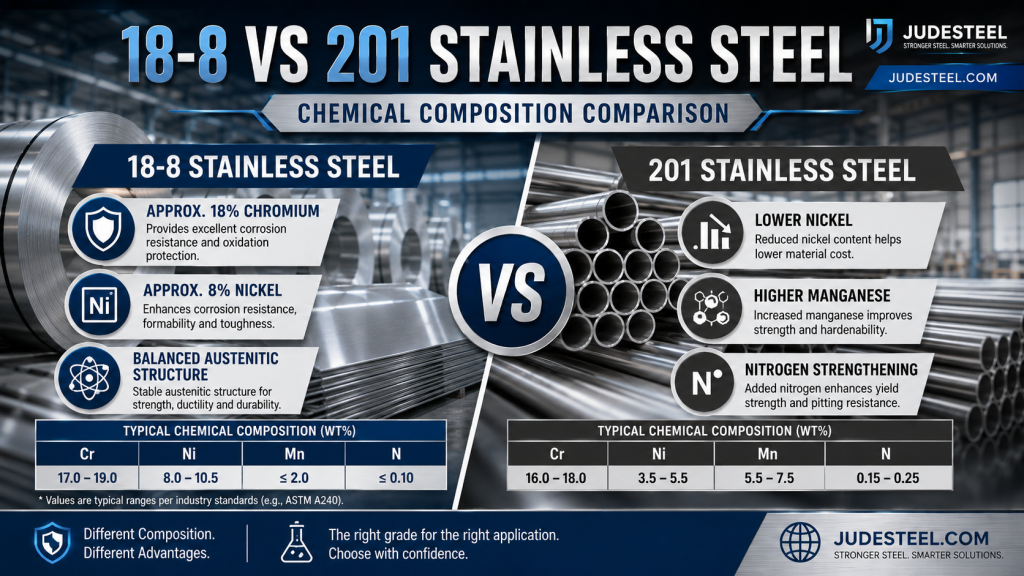
| Элемент | 18-8 Stainless Steel | 201 Stainless Steel |
|---|---|---|
| Chromium (Cr) | Typically around 18% | Usually around 16%–18% |
| Nickel (Ni) | Typically around 8% | Lower, commonly around 3.5%–5.5% |
| Manganese (Mn) | Usually lower | Higher, often around 5.5%–7.5% |
| Nitrogen (N) | Usually low | Added to improve strength and austenitic stability |
| Carbon (C) | Controlled for corrosion and weldability | May be higher than 18-8 depending on specification |
| Primary Design Goal | Balanced corrosion resistance, formability and reliability | Lower cost with useful strength and decorative performance |
Why Nickel Matters
Nickel improves toughness, ductility and corrosion resistance in austenitic stainless steel. When nickel is reduced, cost may decrease, but corrosion resistance and long-term reliability may also be reduced in challenging environments.
4. Corrosion Resistance Comparison
Corrosion resistance is the most important difference between 18-8 and 201 stainless steel. 18-8 stainless steel generally provides better resistance to rust, oxidation and moisture-related corrosion. It is more suitable for kitchens, food equipment, medical devices and many outdoor or semi-outdoor applications.
201 stainless steel can perform well in dry indoor environments, but it is more likely to develop rust spots in humid, salty, acidic or chloride-rich conditions. It should be used carefully when moisture exposure is frequent.
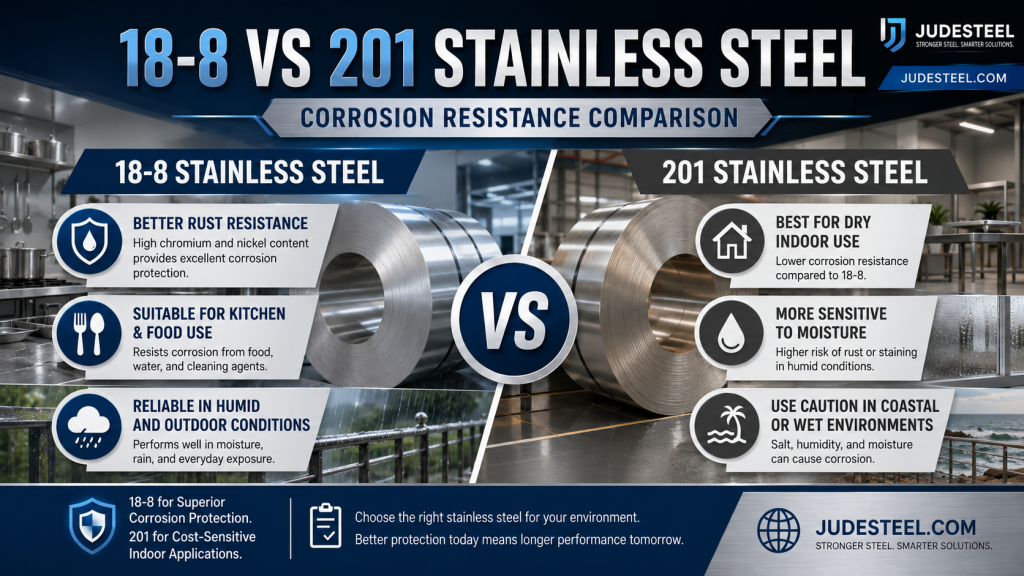
| Environment | Better Choice | Reason |
|---|---|---|
| Dry indoor decoration | 201 Stainless Steel | Lower cost and acceptable corrosion resistance in dry conditions |
| Kitchen equipment | 18-8 Stainless Steel | Better hygiene and corrosion resistance |
| Food processing | 18-8 Stainless Steel | More reliable for cleaning, moisture and food-contact environments |
| Humid indoor environment | 18-8 Stainless Steel | Lower risk of rust and staining |
| Outdoor rain exposure | 18-8 Stainless Steel | Better weather resistance than 201 |
| Coastal or chloride environment | 18-8 or higher-grade stainless steel | 201 is not recommended; 316L may be required for stronger chloride resistance |
5. Strength and Mechanical Properties
201 stainless steel usually has higher strength and hardness than 18-8 stainless steel because of its manganese and nitrogen content. This can be useful for some decorative or structural components, but it may also make forming and deep drawing more difficult.
18-8 stainless steel provides a better balance of strength, ductility and formability. This makes it easier to fabricate into kitchenware, tanks, formed parts and complex components.
| Недвижимость | 18-8 Stainless Steel | 201 Stainless Steel |
|---|---|---|
| Strength | Moderate to good | Higher |
| Твердость | Moderate | Higher |
| Ductility | Превосходно | Good but usually lower than 18-8 |
| Formability | Превосходно | Good, but stronger work hardening may occur |
| Deep Drawing | Better suited | More limited and process-dependent |
| Work Hardening | Moderate | Stronger |
6. Fabrication, Welding and Processing
18-8 stainless steel is easier to form, weld and fabricate in many applications. It is widely used in sheet metal processing, kitchen equipment manufacturing, food machinery and welded structures.
201 stainless steel can also be cut, bent, polished and welded, but its higher strength and work-hardening behavior may require better process control during forming, stamping or bending.
Jude Steel provides stainless steel products and processing services including stainless steel sheet, stainless steel coil, stainless steel strip, laser cutting, bending, brushing and polishing.
| Processing Factor | 18-8 Stainless Steel | 201 Stainless Steel |
|---|---|---|
| Cutting | Easy and widely processed | Easy with proper tools |
| Сгибание | Превосходно | Good, but higher springback may occur |
| Welding | Превосходно | Good for general applications |
| Polishing / Brushing | Excellent appearance | Good decorative appearance |
| Deep Forming | Better | More limited |
| Production Stability | High | Requires more control in demanding processes |
7. Cost Comparison
Cost is the main reason many buyers consider 201 stainless steel instead of 18-8 stainless steel. Because nickel is a major cost factor in stainless steel, reducing nickel content can significantly lower raw material cost.
However, lower purchase price does not always mean lower lifecycle cost. If 201 stainless steel rusts, stains, requires frequent cleaning or needs replacement earlier, the total cost may become higher than using 18-8 from the beginning.
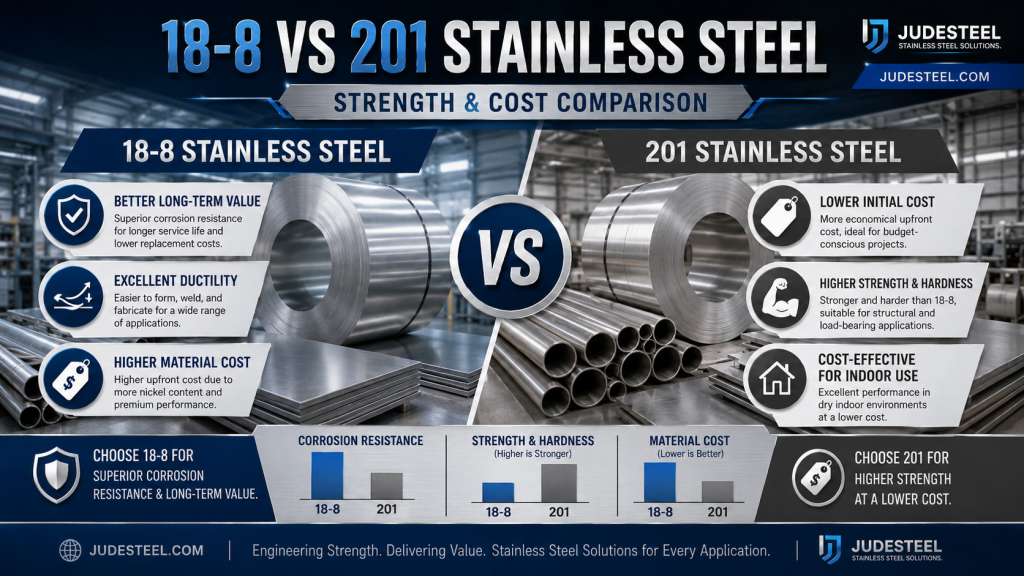
| Cost Factor | 18-8 Stainless Steel | 201 Stainless Steel |
|---|---|---|
| Raw Material Cost | Higher | Lower |
| Nickel Cost Exposure | Higher | Lower |
| Processing Cost | Stable and predictable | May increase in complex forming |
| Maintenance Risk | Lower in corrosive environments | Higher if used in humid or outdoor environments |
| Replacement Risk | Lower when correctly specified | Higher if grade is used beyond its environment limit |
| Best Cost Scenario | Food, outdoor, humid or long-service applications | Dry indoor decorative and low-corrosion applications |
8. Typical Applications of 18-8 Stainless Steel
- Kitchen equipment and cookware
- Food processing machinery
- Restaurant equipment
- Medical and laboratory instruments
- Fasteners, nuts, bolts and screws
- Indoor and outdoor hardware
- Architectural panels and components
- General industrial fabrication
- Storage tanks and process equipment
9. Typical Applications of 201 Stainless Steel
- Indoor decorative stainless steel tubes
- Furniture frames
- Appliance trims and panels
- Interior handrails in dry environments
- Display racks and commercial fixtures
- Decorative wall panels
- Cost-sensitive sheet metal products
- Low-corrosion indoor fabrication
10. 18-8 vs 201 Stainless Steel: Selection Guide
| Project Requirement | Recommended Grade | Reason |
|---|---|---|
| Lowest material cost | 201 Stainless Steel | Lower nickel content reduces cost |
| Food-contact equipment | 18-8 Stainless Steel | Better hygiene, corrosion resistance and reliability |
| Dry indoor decorative use | 201 Stainless Steel | Cost-effective and visually attractive |
| Outdoor or humid environment | 18-8 Stainless Steel | Lower rust risk than 201 |
| Coastal or chloride exposure | 316L or higher-grade stainless steel | 18-8 may be acceptable in mild cases, but 316L is safer for stronger chloride exposure |
| Complex forming or deep drawing | 18-8 Stainless Steel | Better ductility and formability |
| Decorative tubes and furniture | 201 Stainless Steel | Lower cost and good appearance in indoor use |
| Long service life with low maintenance | 18-8 Stainless Steel | Better corrosion resistance and lower failure risk |
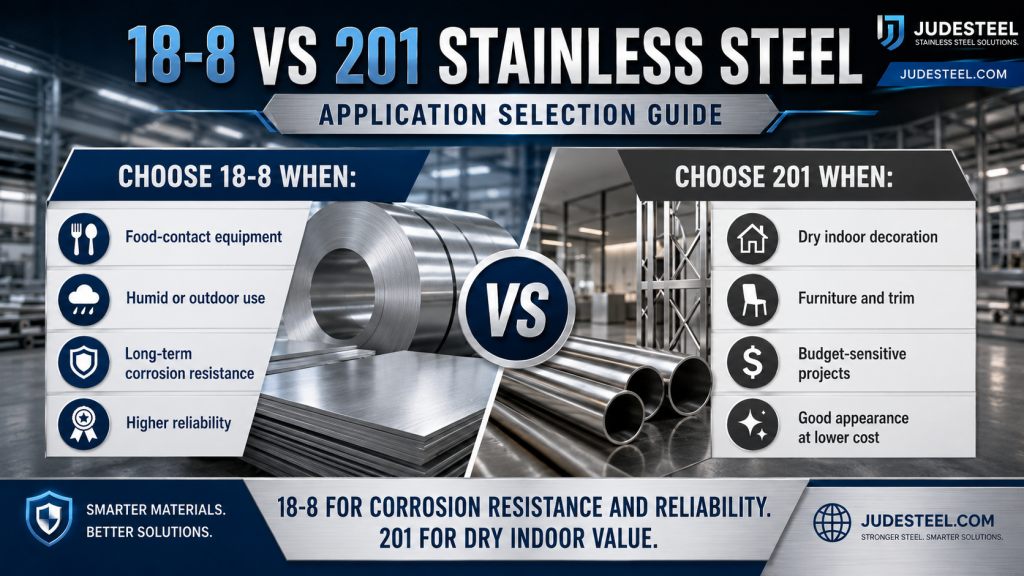
11. Which Grade Should You Choose?
Choose 18-8 Stainless Steel If:
- Corrosion resistance is important
- The product is used in food, kitchen, medical or hygienic environments
- The application may contact moisture or cleaning agents
- Outdoor or semi-outdoor use is expected
- Good weldability and formability are required
- Long service life and low maintenance matter
- Customer quality perception is important
Choose 201 Stainless Steel If:
- Cost control is the main priority
- The application is dry and indoor
- The product is decorative rather than safety-critical
- Higher strength and hardness are useful
- The environment has low moisture and low chloride exposure
- The product is furniture, trim, panel or decorative tube
- Shorter service life or lower corrosion demand is acceptable
Consider Other Grades If:
- 304 is not corrosion resistant enough
- 316L is required for marine or chloride exposure
- 430 is acceptable for low-cost magnetic decorative applications
- 439 or 441 is needed for automotive exhaust or high-temperature ferritic use
- Duplex stainless steel is required for higher strength and chloride resistance
12. Common Buyer Mistakes to Avoid
- Choosing 201 only because it looks similar to 18-8
- Using 201 stainless steel in wet, coastal or outdoor environments
- Ignoring nickel content when comparing corrosion resistance
- Comparing only price per ton and ignoring maintenance cost
- Using 201 for food-contact applications without proper evaluation
- Assuming polished appearance means high corrosion resistance
- Ignoring work-hardening behavior during forming
- Not confirming material certificates and grade standards before purchase
The correct material should be selected according to environment, service life, corrosion risk, fabrication process, appearance requirements and total lifecycle cost.
Frequently Asked Questions
What does 18-8 stainless steel mean?
18-8 stainless steel usually means a stainless steel with approximately 18% chromium and 8% nickel. It commonly refers to 304-family stainless steel used in cookware, fasteners, food equipment and general applications.
What is the main difference between 18-8 and 201 stainless steel?
18-8 stainless steel contains higher nickel and provides better corrosion resistance. 201 stainless steel contains less nickel and more manganese, making it lower cost and higher strength but less corrosion resistant.
Is 201 stainless steel stronger than 18-8 stainless steel?
201 stainless steel usually has higher strength and hardness due to manganese and nitrogen. However, 18-8 stainless steel offers better ductility, formability and corrosion resistance.
Which is more corrosion resistant, 18-8 or 201 stainless steel?
18-8 stainless steel is generally more corrosion resistant than 201 stainless steel. It performs better in humid, kitchen, food-contact and outdoor environments.
Does 201 stainless steel rust?
Yes. 201 stainless steel can rust in humid, salty, acidic or chloride-rich environments. It is best used in dry indoor decorative applications.
Is 18-8 stainless steel food safe?
18-8 stainless steel is widely used in cookware, kitchen equipment and food processing applications because of its good corrosion resistance, cleanliness and formability.
Can 201 stainless steel replace 18-8 stainless steel?
201 stainless steel can replace 18-8 only in selected cost-sensitive indoor decorative applications. It should not be used as a direct replacement where corrosion resistance, hygiene or long-term reliability is required.
Заключение
18-8 stainless steel and 201 stainless steel are both austenitic stainless steels, but they are designed for different priorities. 18-8 stainless steel provides better corrosion resistance, weldability, formability and long-term reliability. It is the better choice for food equipment, kitchenware, medical instruments, outdoor hardware, fasteners and general industrial use.
201 stainless steel offers lower cost and higher strength, making it attractive for indoor decorative tubes, furniture, appliance trim and cost-sensitive applications. However, it should be used carefully in humid, coastal, chloride-rich or food-contact environments because its corrosion resistance is lower than 18-8 stainless steel.
The best choice depends on your environment and performance requirement. Choose 18-8 when reliability and corrosion resistance matter. Choose 201 when the application is dry, indoor, decorative and cost-sensitive. Jude Steel supplies stainless steel sheets, coils, strips and processing services for global buyers. Explore more at Judesteel.com, or visit our product pages for stainless steel sheet, stainless steel coil and stainless steel strip.
